How to Keep Poultry Farm Records: A Practical Guide for Beginners
Most poultry farmers do not fail because they lack chickens or customers. They fail because they cannot answer simple questions like “How much did I actually spend this month?” or “Which batch of birds gave me the best return?” Without records, every decision on the farm becomes a guess.
Keeping poultry farm records means tracking flock numbers, feed use, mortality, health treatments, egg or meat production, and expenses in a consistent format — daily, weekly, and monthly — so you can spot problems early, calculate profit accurately, and make better management decisions.
This guide walks you through exactly what to record, how to set up a simple record-keeping system (even without a computer), and how to use those records to run a more profitable and disease-resistant poultry operation, whether you are raising broilers, layers, or backyard chickens in Nigeria, Ghana, Kenya, Uganda, Cameroon, the USA, or elsewhere.
Table of Contents
- Why Poultry Farm Records Matter
- The Main Types of Poultry Farm Records
- Daily Records You Should Keep
- Weekly and Monthly Records
- Health and Vaccination Records
- Financial Records and Profit Tracking
- Tools for Record-Keeping: Paper vs Digital
- Simple Record-Keeping Templates
- Common Mistakes Farmers Make
- How Records Support Biosecurity and Disease Control
- Frequently Asked Questions
Why Poultry Farm Records Matter
Records matter because they turn guesswork into facts. They help you calculate real profit, detect disease outbreaks early, track feed efficiency, and provide proof of performance if you ever need a loan or want to sell the farm.
Many small-scale farmers keep everything “in their head.” This works for a week or two. It breaks down once you have more than one batch of birds, more than one worker, or a disease outbreak that requires you to explain what happened.
Good records help you answer practical questions such as:
- Am I actually making a profit, or just moving money around?
- Which supplier’s feed gives better weight gain?
- Is my mortality rate normal, or is something wrong?
- How does this batch compare to the last one?
- What will I owe in feed and labor costs next month?
For readers who are still setting up their operation, our guide on How to Start a Poultry Farming Business covers the planning steps that come before record-keeping.
The Main Types of Poultry Farm Records
A functional poultry farm typically needs five categories of records: flock/production records, feed records, health records, financial records, and equipment/maintenance records.
| Record Type | What It Tracks | How Often |
|---|---|---|
| Flock/Production | Bird count, mortality, egg count, weight gain | Daily |
| Feed | Feed type, quantity given, feed conversion ratio | Daily |
| Health | Vaccinations, treatments, symptoms observed | As it happens |
| Financial | Expenses, sales, profit/loss | Weekly/Monthly |
| Equipment | Repairs, replacements, cleaning schedule | Monthly |
You do not need all five from day one if you are running a very small backyard flock. But as soon as you sell eggs or birds commercially, all five become important.
Daily Records You Should Keep
Daily records should include the number of birds alive, number of deaths, feed given, water consumption if measurable, egg count (for layers), and any unusual behavior or symptoms.
These are the records that catch problems while they are still small. A sudden jump in mortality, a drop in feed intake, or a fall in egg production is often the first sign of disease, heat stress, or a management issue.
What to write down each day
- Date
- Number of birds alive at the start of the day
- Number of deaths, and if possible, a brief note on cause (found dead, culled, injured)
- Feed type and quantity given
- Water source condition (clean, adequate, any issues)
- Egg count, for layers, split by grade if you sort eggs
- Any observed symptoms: coughing, diarrhea, reduced activity, ruffled feathers
- Weather notes on unusually hot, cold, or wet days
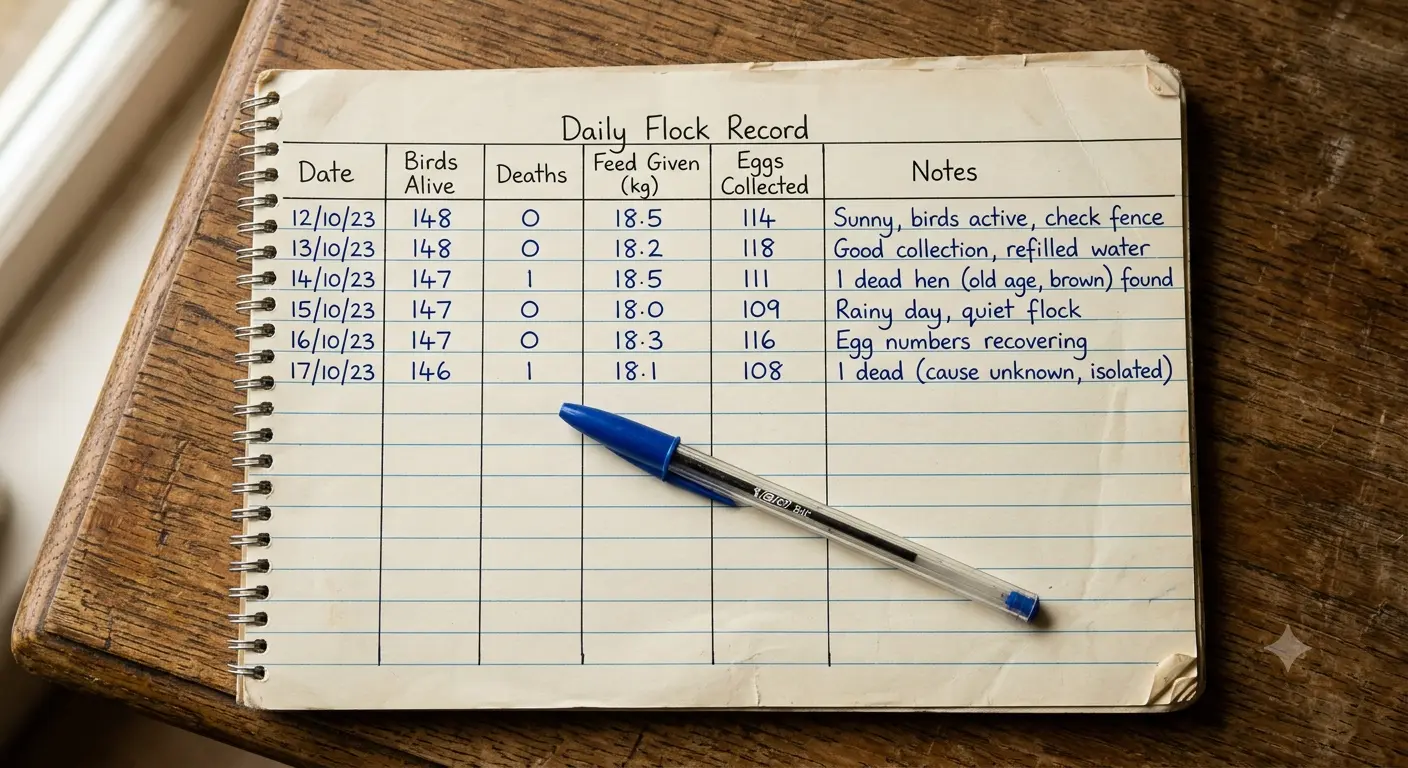
You do not need a computer for this. A simple exercise book kept near the coop, with one row per day, is enough for most small and medium farms.
Weekly and Monthly Records
Weekly and monthly records summarize the daily data into totals and averages, such as total mortality rate, average feed conversion ratio, and total egg or meat production, so you can compare performance across time periods.
Daily notes are useful, but they become truly powerful once you total them up. At the end of each week, calculate:
- Total mortality for the week and mortality rate (deaths ÷ starting bird count × 100)
- Total feed consumed and cost of feed for the week
- Total eggs collected, or total weight gain for broilers if you weigh a sample
- Feed conversion ratio (feed consumed ÷ weight gained, for broilers)
Monthly, roll these weekly totals into a summary sheet. This is also the point where you calculate your monthly profit or loss, which is covered in the financial records section below.
Health and Vaccination Records
Health records should log every vaccination, medication, and treatment given, including the date, product used, dosage, and the batch of birds treated, so you can track withdrawal periods and avoid repeating unnecessary treatments.
This category deserves extra attention because it protects both your flock’s health and your customers’ safety.
What a health record should include
- Date of vaccination or treatment
- Disease being prevented or treated
- Product name and dosage administered
- Route of administration (drinking water, injection, eye drop, spray)
- Batch or house identification
- Withdrawal period before eggs or meat can be sold, where applicable
- Name of the person who administered treatment, or the veterinary professional consulted
Vaccination schedules and required disease-control programs vary significantly by country. Nigeria, Ghana, Kenya, Uganda, Cameroon, and the USA each have different government-recommended or mandatory vaccination schedules and veterinary regulations. Always confirm current requirements with your local veterinary authority or an accredited animal health professional rather than relying on a generic schedule found online.
If a disease outbreak occurs, do not attempt to diagnose or treat it based on internet searches alone. Contact a qualified veterinarian or livestock extension officer. Good health records make that consultation faster and more accurate, because you can show exactly what has already been done.
For more on recognizing early symptoms, see our guide on Common Poultry Diseases and Early Warning Signs.
Financial Records and Profit Tracking
Financial records should separate income (egg sales, bird sales, manure sales) from expenses (feed, chicks, medication, labor, utilities, equipment) so you can calculate a true profit or loss figure for each batch or time period.
Many farmers judge success by cash in hand rather than actual profit. This is misleading. You can have plenty of cash moving through the farm while still losing money, especially if feed costs are rising or mortality is high.
Basic expense categories to track
- Day-old chicks or point-of-lay birds
- Feed (the largest recurring cost on most farms)
- Vaccines and medication
- Labor, including your own time if you pay yourself
- Housing and equipment depreciation or repair
- Utilities: water, electricity, fuel for heating or lighting
- Transport for feed, chicks, or product delivery
Basic income categories to track
- Egg sales
- Live bird or dressed meat sales
- Manure or litter sales, where applicable
- Any culled or spent bird sales
At the end of each production cycle, subtract total expenses from total income to get your net profit or loss for that batch. Comparing this figure across multiple batches tells you far more than looking at a single cycle in isolation.
Tools for Record-Keeping: Paper vs Digital
A paper exercise book or printed template works well for small and backyard flocks, while a spreadsheet or basic farm-management app becomes more useful once you manage multiple houses, batches, or workers.
| Method | Best For | Pros | Cons |
|---|---|---|---|
| Paper notebook | Small/backyard flocks, low-literacy settings | Cheap, no power or internet needed, simple | Hard to analyze trends, easy to lose or damage |
| Printed templates | Small-medium farms with 1-2 workers | Structured, easy to train staff on | Still manual totaling |
| Spreadsheet (phone or computer) | Medium-large farms, multiple batches | Automatic calculations, easy comparisons over time | Requires device and basic digital skills |
| Farm management app | Commercial operations | Reminders, reports, sometimes multi-user access | May require subscription and reliable internet |
There is no single “correct” tool. The right choice depends on your farm size, your comfort with technology, and whether you have reliable electricity or internet access. Many successful small-scale farmers in Sub-Saharan Africa still use paper templates effectively, especially when combined with a monthly phone-based summary.
Simple Record-Keeping Templates
A basic daily flock record needs only six columns: date, birds alive, deaths, feed given, eggs collected, and notes. This can be copied by hand into a notebook or recreated in any spreadsheet program.
Daily Flock Record Template
| Date | Birds Alive | Deaths | Feed Given (kg) | Eggs Collected | Notes |
|---|---|---|---|---|---|
Monthly Financial Summary Template
| Category | Amount |
|---|---|
| Total Income | |
| Feed Cost | |
| Chicks/Birds Cost | |
| Medication/Vaccination Cost | |
| Labor Cost | |
| Other Expenses | |
| Net Profit/Loss |
You can photocopy these templates into a notebook, print them, or rebuild them in any spreadsheet software. Keep the format consistent from batch to batch so comparisons remain accurate.
Common Mistakes Farmers Make
The most common record-keeping mistakes are recording data inconsistently, mixing personal and farm expenses, forgetting to record small deaths or free losses, and never reviewing the records once they are written down.
- Inconsistent recording: Writing daily numbers for a week, then skipping two weeks, makes trend analysis impossible.
- Mixing personal and farm money: This makes it look like the farm is more or less profitable than it really is.
- Ignoring small losses: A death here and there feels unimportant, but untracked mortality hides a rising trend until it becomes a serious outbreak.
- Never reviewing the data: Records that are filled in but never analyzed provide no value. Set aside time weekly or monthly to actually look at the numbers.
- No backup: A single paper notebook can be lost, damaged by rain, or eaten by pests. Consider photographing pages with a phone as a simple backup.
How Records Support Biosecurity and Disease Control
Accurate records let you detect mortality spikes and symptom patterns early, trace which batch or house a problem started in, and give a veterinarian the information needed to respond quickly, which reduces the severity and spread of disease outbreaks.
Disease control in poultry depends heavily on early detection. A mortality rate that quietly climbs from 1% to 3% over two weeks is far easier to manage than one that is only noticed after it hits 15%. Without daily records, that gradual rise is almost impossible to catch in time.
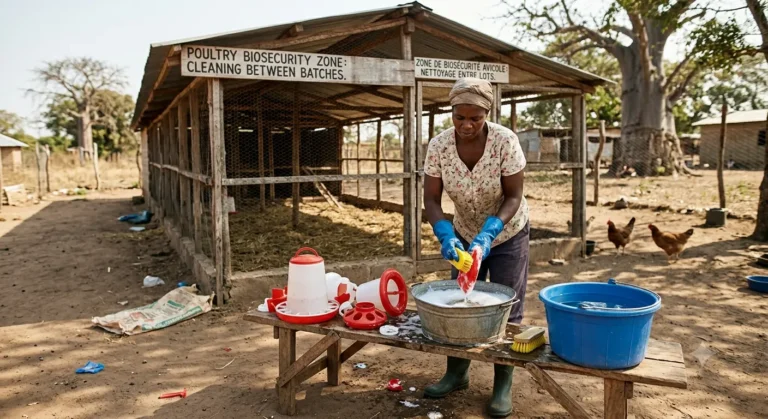
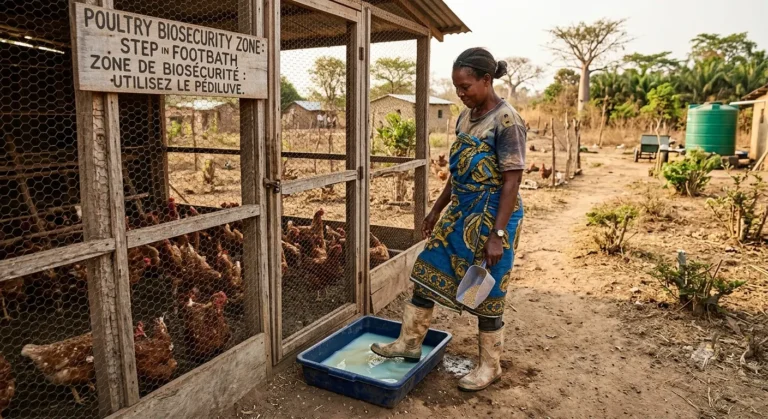
Records also help with biosecurity planning. If you keep separate logs for each house or batch, you can trace whether a problem is isolated to one area (suggesting a local cause like poor ventilation or contaminated feed) or spread across the farm (suggesting an airborne or waterborne disease).
For a deeper look at farm-level prevention practices, see our guide on Poultry Biosecurity Basics for Small-Scale Farmers.
Frequently Asked Questions
How often should I update poultry farm records?
Flock, feed, and mortality records should be updated daily. Financial and performance summaries are best reviewed weekly, with a full profit-and-loss calculation done monthly or at the end of each production cycle.
Do I need a computer to keep poultry farm records?
No. A notebook and pen are sufficient for most small and backyard flocks. A spreadsheet or app becomes more useful once you manage multiple batches, houses, or workers, but it is not required to start.
What is the most important record for a beginner poultry farmer?
Daily mortality and feed records are the most important starting point, since they reveal health problems early and directly affect your largest recurring cost.
How do I calculate feed conversion ratio?
Divide the total feed consumed by the total weight gained over the same period. A lower ratio generally means birds are converting feed into weight more efficiently, though acceptable ranges vary by breed and production system.
Should I keep separate records for each poultry house or batch?
Yes, where possible. Separate records make it much easier to trace the source of a health or performance problem, compare batches fairly, and calculate profit per batch rather than for the whole farm at once.
How long should I keep old poultry farm records?
Many farmers keep at least 2–3 years of records for financial and tax purposes, and longer for health and vaccination history, since this history can help a veterinarian identify recurring problems.
Are farm record templates different for layers versus broilers?
The core categories are similar, but layers need an added egg-production log (including grading), while broilers benefit more from close weight-gain and feed-conversion tracking, since growth rate is the main performance measure.
Can poor record-keeping affect my ability to get a loan or grant?
Yes. Lenders and grant programs often ask for basic production and financial history before approving support. Consistent records make it easier to demonstrate that your farm is well managed and creditworthy.
Conclusion
Record-keeping is not paperwork for its own sake. It is the difference between running a poultry farm by instinct and running it with facts you can act on. Start small: a daily notebook tracking birds, feed, deaths, and eggs is enough to begin seeing patterns within a few weeks.
As your farm grows, add financial and health tracking, and consider moving to a spreadsheet or simple app once paper records become hard to manage. The goal is not a perfect system on day one, but a consistent one that you actually use.
If you are still setting up your flock, our guide on How to Start a Poultry Farming Business is a good next step.
If disease prevention is your main concern right now, see Poultry Biosecurity Basics for Small-Scale Farmers.