Poultry Feed Guide for Beginners
Feed is the single biggest cost in poultry farming. In most small and medium broiler operations across Nigeria, Ghana, Kenya, Cameroon, and Uganda, feed accounts for roughly 60–70% of total production costs. Get feeding wrong, and even healthy, well-housed birds will grow slowly, convert feed poorly, or fall sick. Get it right, and you set your flock up for strong weight gain, better egg production, and a healthier bottom line.
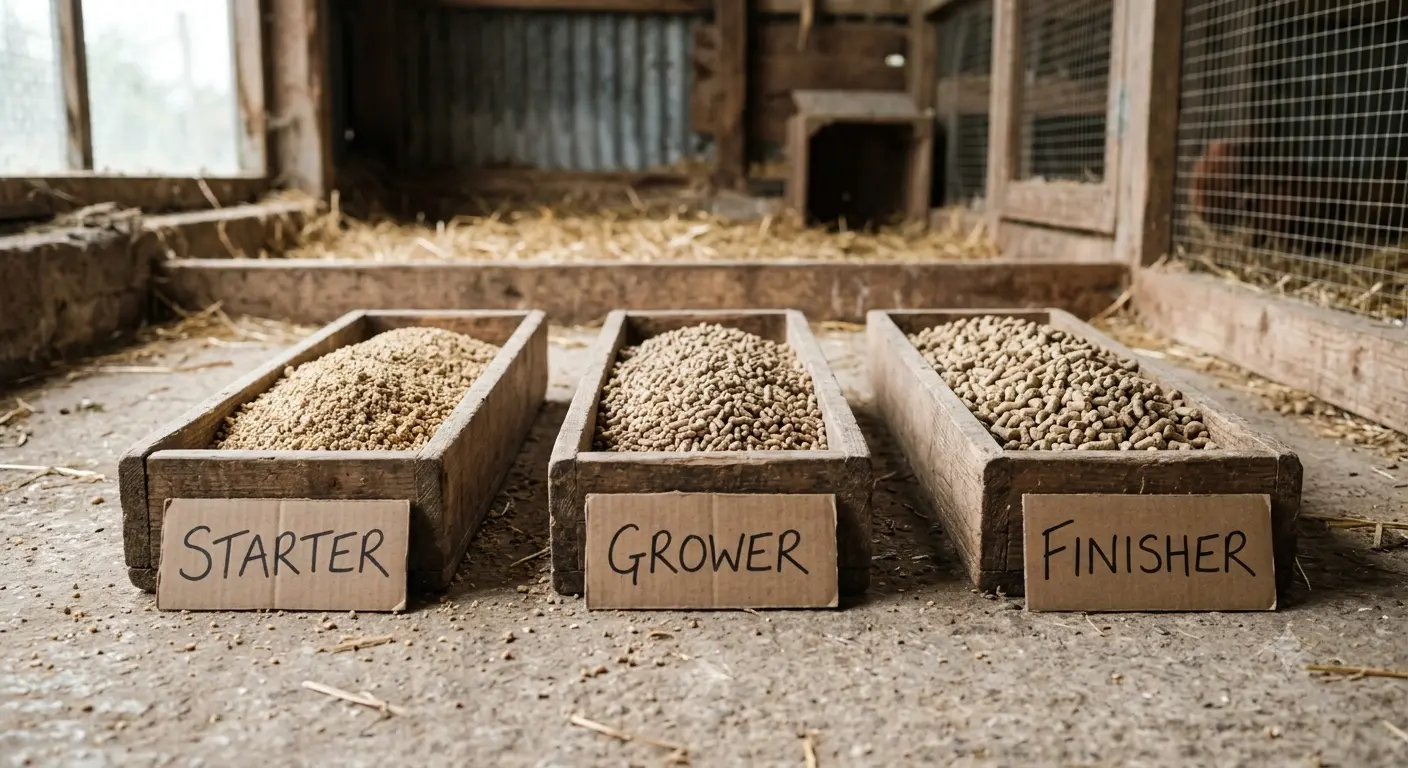
Poultry feed changes as birds grow through three main stages — starter, grower, and finisher (or layer feed for egg-laying birds) — each formulated with different protein and energy levels to match the bird’s age and purpose. Beginners should feed the correct type at each stage, provide clean water at all times, and buy feed only from a trusted supplier or mix it carefully using a tested formula.
Table of Contents
- What Is Poultry Feed and Why It Matters
- Types of Poultry Feed Explained
- Feeding Schedule: How Much and When to Feed
- Understanding Feed Conversion Ratio (FCR)
- Local and Alternative Feed Ingredients for African Farmers
- How to Choose Good Quality Feed
- Feed Storage Tips
- Common Feeding Mistakes Beginners Make
- Managing Feed Costs
- Frequently Asked Questions
What Is Poultry Feed and Why It Matters
Poultry feed is a balanced mix of energy sources (like maize), protein sources (like soybean meal or fishmeal), vitamins, and minerals formulated to meet a bird’s nutritional needs at each stage of growth.
Chickens cannot grow, lay eggs, or fight off disease on maize or kitchen scraps alone. A properly balanced feed supplies energy for movement and body heat, protein for muscle and feather growth, and vitamins and minerals for bone strength, immunity, and egg production. Feeding an unbalanced diet is one of the most common reasons beginner farmers see slow growth, weak birds, or poor egg output even when housing and vaccination are done correctly.
For broilers specifically, feed quality directly affects how quickly birds reach market weight. A well-fed broiler can reach 1.8–2.5 kg in six to eight weeks, while poorly fed birds may take much longer and still weigh less, eating into your profit margin the entire time.
Types of Poultry Feed Explained
The main feed types are starter, grower, and finisher for broilers, and chick mash, grower mash, and layer mash for egg-laying birds. Each stage has a different protein percentage suited to the bird’s age.
Commercial feed is sold in stages because a young chick’s nutritional needs are very different from those of a bird approaching market weight or one that is laying eggs daily. Feeding the wrong stage feed for too long can waste money or slow growth.
| Feed Type | Typical Age Range (Broilers) | Approximate Protein Level | Purpose |
|---|---|---|---|
| Starter (Chick Mash) | Day 1 – 2 to 3 weeks | 21–23% | Supports rapid early growth and immune development |
| Grower | 3 – 5 weeks | 19–20% | Builds muscle and skeletal frame |
| Finisher | 5 weeks to market | 17–18% | Adds final weight before sale, usually cheaper per kg |
| Layer Mash | Point of lay (approx. 18 weeks) onward | 16–18% | Supports consistent egg production and shell strength |
Protein percentages vary slightly between feed brands and countries, so always check the feed bag label rather than relying on protein figures alone. If you are raising local or dual-purpose breeds rather than commercial broilers, growth stages may take longer and feed transitions can be adjusted based on the bird’s actual size rather than age alone.
Feeding Schedule: How Much and When to Feed
Young chicks should have feed available almost constantly (ad-lib feeding), while older birds are usually fed two to three times a day, with total daily intake increasing as they grow — from a few grams per chick to over 100 grams per bird by market age.
The table below gives general estimates for broiler feed intake. These are guidelines, not exact figures — actual consumption varies with breed, temperature, and feed quality.
| Age (Weeks) | Approximate Daily Intake per Bird | Feeding Frequency |
|---|---|---|
| Week 1 | 10–15 g | Feed available most of the day |
| Week 2–3 | 30–50 g | 3–4 times daily |
| Week 4–5 | 70–90 g | 2–3 times daily |
| Week 6–8 | 100–160 g | 2 times daily, often with feed available longer |
Always provide clean, fresh drinking water alongside feed. Birds that are short on water will eat less, and feed conversion suffers even if the ration itself is well formulated. In hot climates common across much of Sub-Saharan Africa, feeding during the cooler parts of the day — early morning and late afternoon — can improve intake, since birds tend to eat less during peak heat.
Understanding Feed Conversion Ratio (FCR)
Feed Conversion Ratio (FCR) measures how much feed a bird eats to gain one kilogram of body weight. A lower FCR means more efficient, more profitable feeding.
FCR is calculated as: total feed consumed (kg) ÷ total live weight gained (kg). For example, if a broiler eats 4 kg of feed total and reaches a live weight of 2 kg, the FCR is 2.0. Well-managed commercial broiler flocks often achieve an FCR between 1.6 and 2.0, though this depends heavily on breed, feed quality, health status, and housing conditions.
Tracking FCR helps you spot problems early. A rising FCR over time can signal poor feed quality, disease, overcrowding, heat stress, or feed wastage from poorly designed feeders. New farmers do not need to calculate FCR daily, but keeping simple records of feed bags used and bird weights at intervals makes it possible to catch issues before they become costly.
Local and Alternative Feed Ingredients for African Farmers
Many small-scale farmers reduce feed costs by supplementing or partially replacing commercial feed with local ingredients such as maize bran, cassava peel meal, groundnut cake, brewer’s spent grain, and kitchen or farm waste — but these must be used carefully and in the right proportions.
Commercial feed is often the most reliable option for beginners because it is pre-balanced and consistent. However, in areas where commercial feed is expensive or hard to access, some farmers use locally available ingredients to supplement rations. Common examples include:
- Maize bran and maize offal — an energy source, widely available in Nigeria, Kenya, and Uganda
- Cassava peel meal — used in West and Central Africa as a partial energy source, but must be properly dried and processed to reduce cyanide content
- Groundnut cake or soybean meal — protein sources, though soybean meal generally offers more consistent quality
- Brewer’s spent grain — a by-product from local breweries, useful but spoils quickly and should be used fresh
- Fishmeal or blood meal — protein boosters, but quality and freshness vary significantly by supplier
Formulating your own feed can lower costs, but it requires knowledge of nutrient balancing to avoid deficiencies that stunt growth or reduce egg output. Beginners who want to try local feed formulation should work with an agricultural extension officer, a livestock nutritionist, or a reputable local feed mill rather than guessing proportions. Poorly balanced homemade feed is one of the most common causes of disappointing results among first-time poultry farmers.
How to Choose Good Quality Feed
Good poultry feed should smell fresh (not musty or rancid), be free of visible mold or insects, have a consistent texture, and come from a supplier with a reliable reputation and clear labeling of protein content and production date.
Before buying feed, especially in bulk, check for these signs:
- No musty, sour, or rancid smell, which can indicate mold or spoiled fat
- No clumping, which often means the feed absorbed moisture during storage
- No visible weevils, moths, or insect activity in the bag
- A clear label showing protein percentage, batch or production date, and manufacturer details
- Consistent color and texture compared to previous purchases from the same brand
If possible, buy from suppliers other local farmers already trust, and avoid feed that has been stored for long periods in hot, humid conditions, since heat and moisture speed up nutrient breakdown and mold growth.
Feed Storage Tips
Store poultry feed in a cool, dry, rodent-proof area, off the ground, and use it within 4–6 weeks of milling to preserve nutrient quality.
Feed nutrients — especially vitamins — degrade over time, faster in hot and humid climates. To protect your investment:
- Store bags on wooden pallets or raised platforms, never directly on a concrete or earth floor
- Keep the storage area dry and well ventilated to prevent mold
- Use older stock first (first in, first out) to avoid feed sitting too long
- Seal bags tightly between uses to keep out rodents and insects
- Avoid buying more feed than you can use within about a month, unless you have proper long-term storage facilities
Common Feeding Mistakes Beginners Make
The most common beginner mistakes are switching feed types abruptly, underfeeding to save money, using expired or spoiled feed, and not providing enough water or feeder space for all birds to eat comfortably.
- Sudden feed changes — switching from starter to grower feed abruptly can cause digestive upset; transition gradually over 2–3 days by mixing both feeds
- Underfeeding to cut costs — this often backfires, since underfed birds grow slower and take longer to reach market weight, increasing overall costs
- Insufficient feeder or drinker space — overcrowded feeders lead to uneven growth, as stronger birds eat more and weaker ones fall behind
- Ignoring water quality — dirty or algae-filled water reduces intake and can introduce disease
- Buying feed based on price alone — the cheapest feed is not always the most cost-effective if it leads to poor growth or higher mortality
Managing Feed Costs
Feed costs can be managed by buying in bulk when prices are favorable, minimizing feed wastage with proper feeders, tracking FCR, and comparing prices across multiple local suppliers before committing to one.
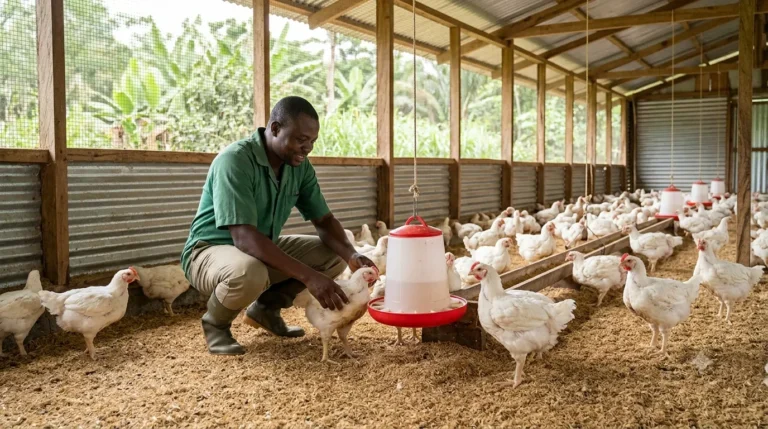
Because feed is such a large share of total costs, small improvements in feed management can meaningfully affect profitability. Practical steps include using trough or hanging feeders that reduce spillage, avoiding overfilling feeders (which encourages birds to scratch feed onto the floor), and keeping simple records of feed cost per kilogram of bird produced. Comparing this figure across production cycles helps you identify whether a change in feed brand, supplier, or formulation actually improved your results.
Frequently Asked Questions
How many times a day should I feed broiler chickens?
Young chicks generally need feed available almost all day, while birds from about four weeks onward are usually fed two to three times daily, with feeders kept available for extended periods as they near market weight.
Can I feed my chickens only kitchen scraps or maize?
No. Kitchen scraps and maize alone do not provide enough protein, vitamins, or minerals for healthy growth or egg production. They can supplement a balanced commercial or properly formulated feed but should not replace it.
How much does poultry feed cost?
Feed prices vary significantly by country, region, and season, and change frequently due to raw material costs like maize and soybean. Check current prices with local feed mills or agro-dealers rather than relying on fixed figures, since costs can shift within weeks.
Is it cheaper to mix my own feed than buy commercial feed?
It can be cheaper in areas with affordable local ingredients, but only if the mix is properly balanced. Poorly formulated homemade feed often costs more in the long run through slower growth, higher mortality, or lower egg output.
What happens if chickens eat too little protein?
Low protein intake leads to slower growth, poor feathering, weaker immunity, and reduced egg production in layers. This is why using the correct feed type for each growth stage matters.
How do I know if my feed conversion ratio is good?
An FCR between roughly 1.6 and 2.0 is generally considered efficient for commercial broilers, though the ideal figure depends on breed, management, and local conditions. Tracking your own FCR over time is more useful than comparing to a single benchmark number.
Can I switch feed brands mid-cycle?
It is best avoided if possible, but if necessary, transition gradually by mixing the old and new feed over a few days rather than switching abruptly, to reduce digestive stress on the birds.
Do layers and broilers need different feed?
Yes. Layer feed is formulated with higher calcium levels to support eggshell formation, while broiler feed is formulated to maximize muscle growth and weight gain. Using the wrong type for extended periods can harm production or bird health.
Conclusion
Feeding correctly is one of the highest-impact decisions a beginner poultry farmer makes. The core principles are simple: match the feed type to the bird’s age and purpose, keep feed fresh and properly stored, provide constant access to clean water, and avoid abrupt changes that stress the flock. If you choose to supplement with local ingredients to manage costs, do so carefully and, where possible, with guidance from a local agricultural extension officer or livestock nutritionist, since poorly balanced rations are one of the most common reasons new farmers see disappointing growth or egg production.
Start small, keep simple feed and weight records from your very first batch, and use that data to refine your feeding approach over time.